
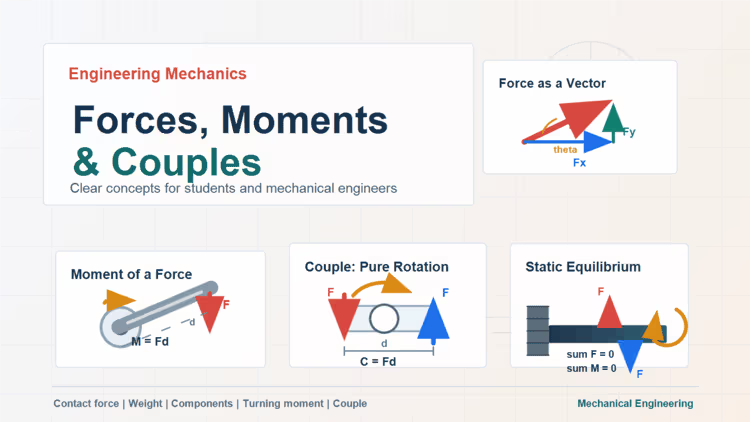
Forces, moments and couples are fundamental concepts in engineering mechanics. They help engineers understand how bodies move, rotate, deform or remain in equilibrium.
In mechanical engineering, these ideas are used in the design and analysis of machines, structures, tools, beams, shafts, brackets, frames and many other components.
This article explains these concepts in a simple and structured way.
What Is a Force?
A force arises from the action or reaction of one body on another.
Although a force cannot be directly seen, its effect can be observed. A force may cause a body to:
- Start moving
- Stop moving
- Change direction
- Accelerate
- Deform
- Rotate when applied away from a point
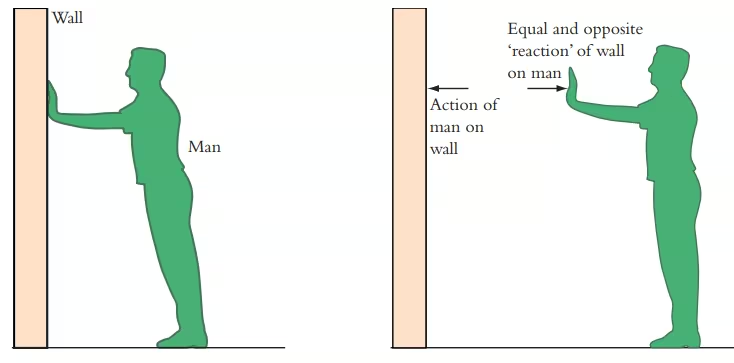
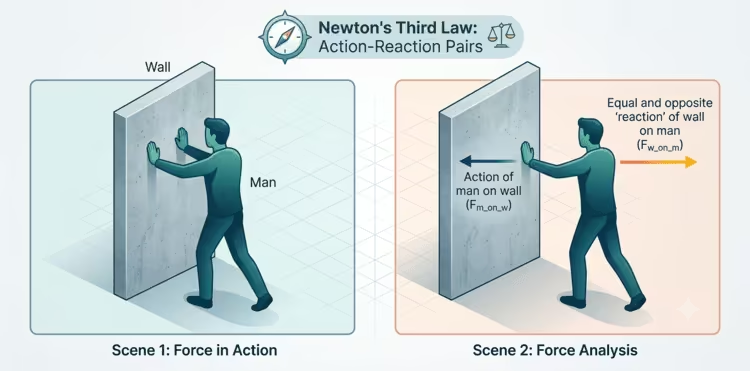
A common example is a person pushing against a wall. The person applies a force on the wall, and the wall applies an equal and opposite force back on the person.
Newton’s Third Law of Motion
Newton’s third law states:
For every action, there is an equal and opposite reaction.
This means that forces always occur in pairs. If body A applies a force on body B, then body B applies an equal and opposite force on body A.
For example:
- A hand pushes a wall.
- The wall pushes the hand back with the same magnitude of force.
- The two forces act in opposite directions.
Types of Forces
Forces can be classified mainly into two types:
1. Contact Forces
A contact force occurs when two bodies physically touch each other.
Examples include:
- A person pushing a wall
- A wheel touching the ground
- A tool pressing against a workpiece
- A beam resting on a support
Contact forces can also occur inside a body. At the microscopic level, molecules and atoms interact with each other and create internal forces.
In engineering mechanics, we usually deal with forces acting at the external surfaces of bodies.
2. Non-Contact Forces
A non-contact force acts without physical contact between bodies.
Common examples include:
- Gravitational force
- Magnetic force
- Electrostatic force
The most familiar example is the force of gravity. The Earth pulls a person downward with a force known as the person’s weight.
Weight acts vertically downward, toward the centre of the Earth.
SI Unit of Force
The SI unit of force is the newton, written as N.
A force of 1 newton is the force required to accelerate a mass of 1 kg at a rate of 1 m/s².
Using Newton’s second law:
F = maWhere:
F= force in newtons, Nm= mass in kilograms, kga= acceleration in metres per second squared, m/s²
Force as a Vector Quantity
A force has both:
- Magnitude
- Direction
Therefore, force is a vector quantity.
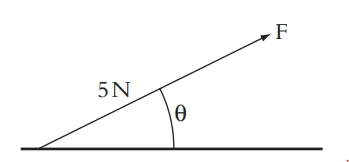
It is usually represented by an arrow. The length of the arrow represents the magnitude of the force, and the arrow direction shows the direction in which the force acts.
For example, a force of 5 N acting at an angle θ to the x-axis can be shown using an inclined arrow.
Resolving a Force into Components
In many engineering problems, it is useful to split a force into two perpendicular components.
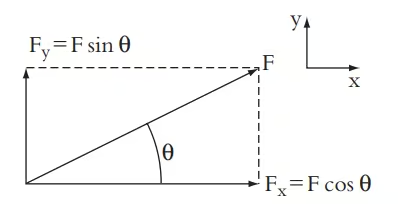
For a force F acting at an angle θ to the x-axis:
Fx = F cos θ
Fy = F sin θ
Where:
Fx= horizontal component of forceFy= vertical component of forceF= magnitude of the forceθ= angle of the force with the x-axis
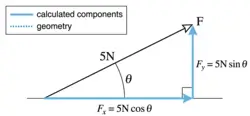
Resolving forces makes it easier to analyse systems with several forces acting in different directions.
Forces and Equilibrium
In this topic, we are mainly concerned with bodies in static equilibrium.
A body is in equilibrium when it has no acceleration and no rotation. This means that all forces and moments acting on the body must balance.
For equilibrium:
Sum of horizontal forces = 0
Sum of vertical forces = 0
Sum of moments = 0
In symbols:
ΣFx = 0
ΣFy = 0
ΣM = 0
These equations are very important in mechanical and structural analysis.
What Is a Moment?
A moment is the turning effect of a force about a point.
The moment of a force depends on:
- The magnitude of the force
- The perpendicular distance from the point to the line of action of the force
The moment is calculated as:
M = FdWhere:
M= momentF= forced= perpendicular distance from the point to the line of action of the force
The SI unit of moment is:
N mor, for larger values:
kN mExample of Moment: Spanner and Nut
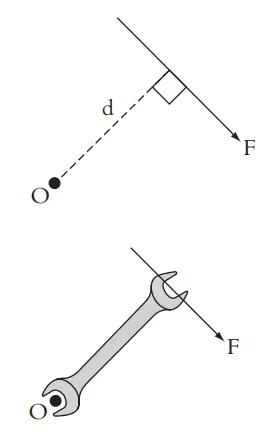
A common example of a moment is using a spanner to turn a nut.
When a force is applied at the end of the spanner, it creates a turning effect about the centre of the nut.
The longer the spanner, the greater the moment for the same applied force.
This is why longer spanners make it easier to loosen tight nuts.
What Is a Couple?
A couple is produced by two equal and opposite parallel forces that do not act along the same line.
A couple does not cause translation because the two forces cancel each other out. However, it creates rotation.
The magnitude of a couple is:
C = FdWhere:
C= coupleF= magnitude of either forced= perpendicular distance between the two forces
A couple is also called a pure moment because it produces rotation without producing a resultant force.
Example of Couple: Wheel Nut Wrench
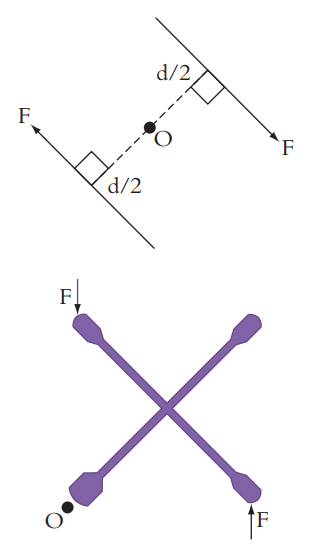
A wheel nut wrench is a practical example of a couple.
When equal and opposite forces are applied at the ends of the wrench, they create a turning effect on the nut.
The nut does not move sideways, but it tends to rotate.
Difference Between Moment and Couple
| Feature | Moment | Couple |
|---|---|---|
| Cause | Produced by a single force about a point | Produced by two equal and opposite parallel forces |
| Resultant force | May have a resultant force | Resultant force is zero |
| Effect | Can cause rotation and translation | Causes pure rotation |
| Depends on reference point | Yes | No |
| Formula | M = Fd | C = Fd |
Moment of a Couple Is Independent of Position
One important property of a couple is that its turning effect is the same about any point on the body.
For example, consider a cantilever beam with a couple of 5 kN m applied at end A. If the couple is created by two equal and opposite forces of 5 kN, separated by 1 m, then the moment felt at other points on the beam remains 5 kN m.
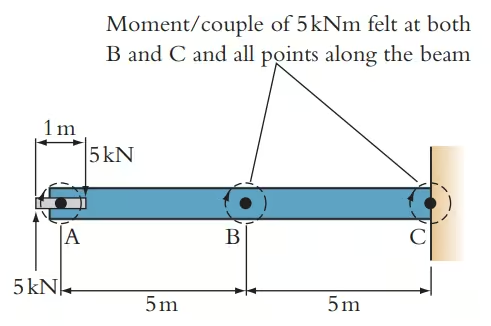
This means that the effect of a couple is independent of the point about which moments are taken.
Practical Importance in Mechanical Engineering
Forces, moments and couples are used in many engineering applications, such as:
- Designing beams and frames
- Analysing machine components
- Calculating support reactions
- Designing shafts and levers
- Studying torque in engines and motors
- Analysing bolts, nuts and fasteners
- Understanding brakes, clutches and gear systems
A strong understanding of these concepts is essential for solving problems in statics, dynamics, strength of materials and machine design.
Key Formulas
Force:
F = ma
Force components:
Fx = F cos θ
Fy = F sin θMoment of a force:
M = FdCouple:
C = FdSummary
A force is an action that can change the state of rest or motion of a body. Forces may be contact forces or non-contact forces, and they are vector quantities with both magnitude and direction.
A moment is the turning effect of a force about a point. A couple is formed by two equal and opposite parallel forces separated by a distance, producing pure rotation.
These concepts form the foundation of engineering mechanics and are essential for analysing machines, structures and mechanical systems.
Leave a Reply